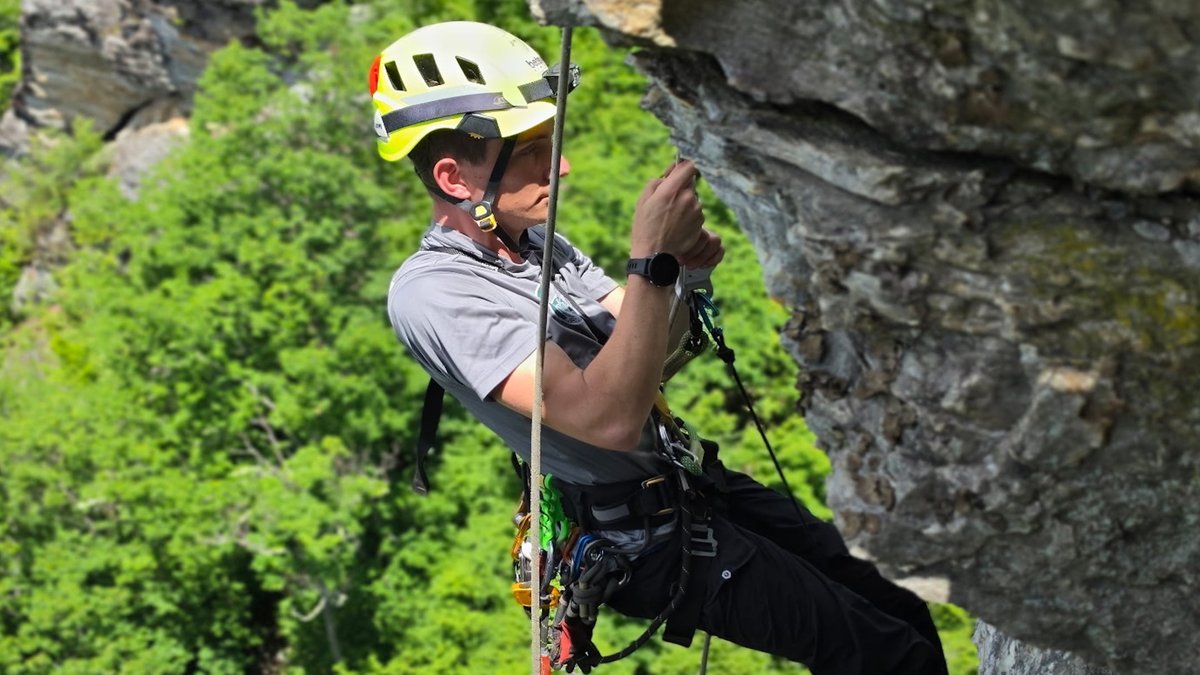
When Jacob Gregory fell 20 feet while leading a climbing route with his son on Shortoff Mountain, rescuers faced a critical problem. The Linville Gorge wall is remote and rugged, and Gregory had suffered serious injuries that required immediate blood transfusion. That’s when Will Soper ran.
A Race Against Time
Soper, 28, is an EMT and technical rescuer with Burke Rescue Inc. and SAR, a volunteer lifesaving unit serving central North Carolina. He was teaching a training session with the Ashe County Rescue Squad about two hours away when the dispatch came through. He packed his gear and drove immediately, knowing the rescue would require every available hand.
Twenty-four agencies responded to the call, including the North Carolina National Guard, which deployed a Black Hawk helicopter. By the time Soper reached the trailhead, a first wave of rescuers had already reached Gregory and were evaluating his condition. His injuries were worse than initially thought.
“When I was about halfway up the mountain I heard Incident Command requesting me: ‘800 to Soper,'” Soper told Outside. “I responded: ‘Go ahead, 800.'”
Related: Empire Builder Trains Hike Cross-Country
A paramedic on scene radioed that Gregory was suffering internal bleeding and needed blood right away. Soper would have to turn around, descend to the parking lot, grab the blood bag, and carry it back up the mountain.
1.5 Miles, 1,000 Feet of Climbing
Shortoff Mountain is known for its steep, rocky summit trail with little protection from the sun. The climbing route Gregory was on sits at the bottom of a 2,800-foot wall, requiring a 200-foot scramble to reach the base. At the bottom of the gully sits what climbers call the “rappel station,” an 80-foot cliff with fixed anchors that provide access to the climbing routes below.
Soper made his way back down to the trailhead, grabbed the blood bag, and packed it in a cooler with cold packs to keep it viable. He placed everything in a backpack and headed back up.
“Off I went,” he said. “In all honesty, ‘run’ is a little bit hyperbolic. I maintained a fast hiking or jogging pace and made sure I didn’t stop for any breaks.”
Related: All‑In‑One Camp Kitchen Offers Instant Running Water
The climb took 31 minutes. Soper covered 1.5 miles while gaining roughly 1,000 feet in elevation. He stayed steady, avoiding overexertion that could cause a dangerous slip on the steep terrain. Reaching the summit, he scrambled down a gully to the rappel station, where he handed his backpack to colleague Robert Vasile, who was waiting with harness and helmet ready for the descent.
“This was the most treacherous part as I was tired and it is the steepest, slickest section,” Soper said. Vasile made the descent smoothly and delivered the supplies to the paramedics waiting below.
Other rescuers worked simultaneously, establishing technical rope systems to reach and treat Gregory. They eventually transported him to Atrium Carolinas Medical Center in Charlotte.
