Zion National Park draws nearly five million visitors a year, leaving visitors like a father in The Narrows struggling to take a simple photo of his son without strangers in the background. The bucket-list hike through knee-deep water is stunning, but the crowds are a constant reality.
Visit rates have doubled in two decades, from 2.5 million in 2005 to almost five million in 2025. That density makes it hard to find a quiet moment on the park’s 146,597 acres.
Fortunately, an alternative exists less than an hour away. Red Cliffs National Conservation Area offers a desert environment just as stunning but with a fraction of the visitors.
A Quiet Alternative to Zion’s Crowds
Red Cliffs spans about 45,000 acres, less than a third of Zion’s size. The smaller area is a benefit. Visitors won’t face mandatory shuttles or need to constantly adjust plans to avoid crowds. The compact size allows for a variety of adventures in a short time.
The area is packed with sandstone cliffs, slot canyons, and miles of slickrock. More than 100 miles of developed trails crisscross the environment. Managed by the Bureau of Land Management, it is a raw desert environment for self-guided exploration. Don’t expect visitor centers or rangers.
Wildlife is another draw. Look for Gila monsters and a rare species of desert tortoise. A writer who explored the area with his son found it so compelling that it made him want to return for more.
Top Trails and Experiences
If only one trail is chosen, make it the Red Reef Nature Trail. The three-mile out-and-back is more of a choose-your-own-adventure. It starts as a mild walk but quickly drops into the heart of a slot canyon. The path narrows as hikers move deeper, requiring light scrambling. One fixed rope helps handle a small waterfall. Deep pockets of water in the narrowest channels can be up to chest-high, but turning back is an option.
After the canyon, the sandstone outcroppings are fun to scramble. It’s an ideal first slot canyon experience, and chances are good of having the area to oneself after the initial waterfall.
Mountain bikers can try the Church Rock and Dino Cliffs Loop, a 7.5-mile route mostly on slickrock with some steep climbs and sandy washes. The Dino Cliffs Trail features 17 well-preserved dinosaur tracks from the Jurassic period.
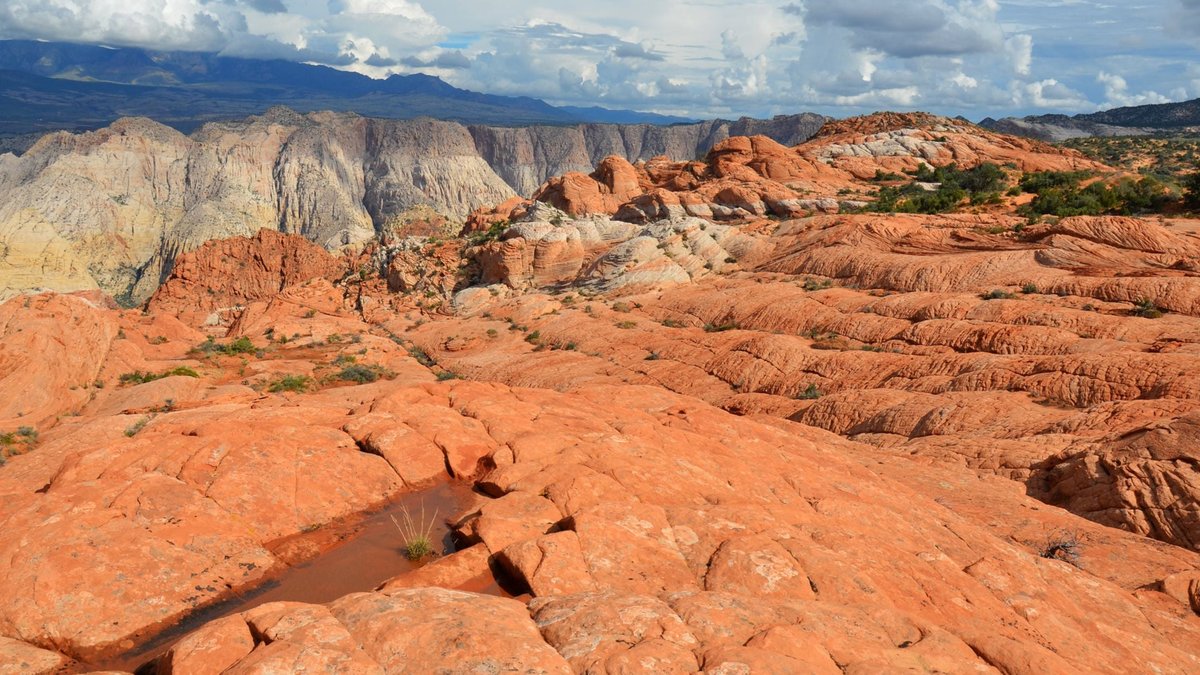
It features cliffs, petrified dunes, and black lava rock. The Petrified Sand Dunes Trail offers a 1.2-mile out-and-back across rolling humps of hardened sandstone. The Lava Flow Trail, a one-mile out-and-back, lets hikers explore three lava tubes, requiring a headlamp to scramble inside.
Red Cliffs also holds a small arch, just 10 feet wide and eight feet tall. A 2.2-mile out-and-back from the Sand Cove trailhead leads to it, traversing singletrack, slickrock, and a steep sand dune. A side trail offers access to the Virgin River for a swim.
The Red Mountain Wilderness, an 18,700-acre area north of Snow Canyon, features the Red Mountain Trail. A 2.3-mile segment climbs from a sandy desert to a sandstone outcropping with an overlook of Snow Canyon and the St. George valley.
Two campgrounds are available. Red Cliffs Campground has 11 sites near the Red Reef Trail for $15 per night. Sand Cove Campground is a primitive, backcountry group site for 20 people, accessible only by 4WD vehicle and requiring a free permit.
Entrance to the conservation area costs a $5 daily fee per car. The best time to visit is from fall through spring for mild temperatures.
Planning Your Visit
The Red Cliffs Desert Reserve also contains Snow Canyon State Park, a 7,400-acre area with cliffs and petrified dunes.
The nearby town of St. George is 15 minutes away and offers dining options.
