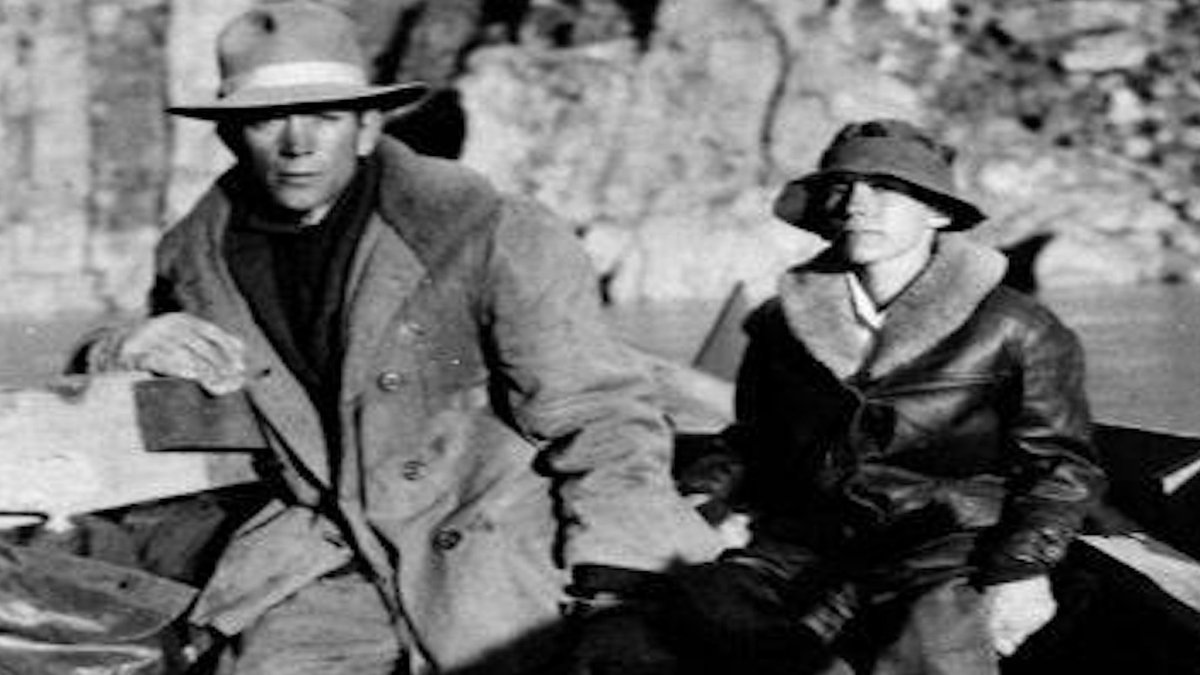
In October 1928, Glen and Bessie Hyde embarked on a journey down the Colorado River, aiming to set a new world record. The couple’s attempt to paddle from Green River, Utah, through the Grand Canyon was cut short when they mysteriously vanished. Their last known sighting was on November 18, 1928. Three weeks later, rescuers found their abandoned, fully loaded boat near river mile 237. Their bodies were never recovered.
A Fateful Expedition
According to Peter Runge, a historian at Northern Arizona University, the disappearance of the Hydes remains one of the most baffling unsolved cases in the history of the Grand Canyon. Runge notes that while the archives contain some clues, the mystery surrounding the couple’s fate endures. In 1996, author Brad Dimock published a book titled Sunk Without a Sound, which explores the lives of Glen and Bessie. The book reveals that Glen was an experienced outdoorsman, having rowed the Salmon and Snake Rivers in Idaho, and that he met Bessie while traveling from San Francisco to Los Angeles in 1925. The couple married in April of the following year, just six months before embarking on their ill-fated expedition.
The Grand Canyon can be a treacherous place, particularly in November, when the weather is prone to sudden changes. At the time of the Hydes’ voyage, the Colorado River was undammed, making the environment even more hazardous. Runge observes that the photographs of Bessie taken during the trip show a decline in her enthusiasm and energy over time. In the last known photo, she appears tired and exhausted. The couple’s clothing, which included heavy leather, wool, and fur jackets, would have made it difficult for them to move and swim freely if they had gotten wet.
Glen designed and built the 20-foot wooden sweep boat, named Rain-in-the-Face, which the couple used for their expedition. Unlike a rowboat or raft, a sweep boat has oars at the bow and stern that are used to counterbalance the vessel. This design allows the boat to change direction as it moves downstream, but it is not well-suited for working through the robust rapids of the Colorado River. Runge suggests that the boat’s cumbersome design may have contributed to the couple’s disappearance, possibly causing them to be thrown from the vessel when it hit a rapid or underwater rock formation.
The scow is almost as if it’s a coffin without a lid. According to Runge, the boat likely hit a rock formation beneath the surface of the water, ejecting Glen and Bessie. Everything, all of their belongings, was found on the boat—cameras and diaries—the only things missing were Glen and Bessie.
Enduring Theories and Legends
A woman named Elizabeth Cutler claimed in 1971 to be Bessie and alleged that she had stabbed her husband during a fight before abandoning their boat and hiking out of the Grand Canyon. Cutler later recanted, and no evidence supported her story.
Another theory centers on Georgie White, a pioneering river runner who became the first woman to own a commercial rafting business in the Grand Canyon. After her death in 1992, investigators reportedly found the Hydes’ wedding license and a birth certificate identifying Clark as Bessie DeRoss among her belongings. However, the theory has a major flaw: Clark’s timeline does not align with Bessie Hyde’s disappearance. “It’s very unlikely Georgie was Bessie,” Runge said, noting that White had her own tragic story, but it was not related to the Hydes’ disappearance.
A third theory emerged after investigators discovered a skeleton in the garage of Emery Kolb, a Grand Canyon photographer and early canyon resident, following his death. The remains, believed to have been found around 1919, were accompanied by clothing fragments and a canvas canoe suspended from the rafters. In 1980, an Arizona Daily Sun article speculated that the bones might belong to one of the Hydes. But a medical examiner identified the skeleton as that of a young man, approximately six feet tall, with a bullet lodged in his skull. An Associated Press report the following year suggested the remains could be Glen. No evidence supported the theory, and the case remained unresolved.
